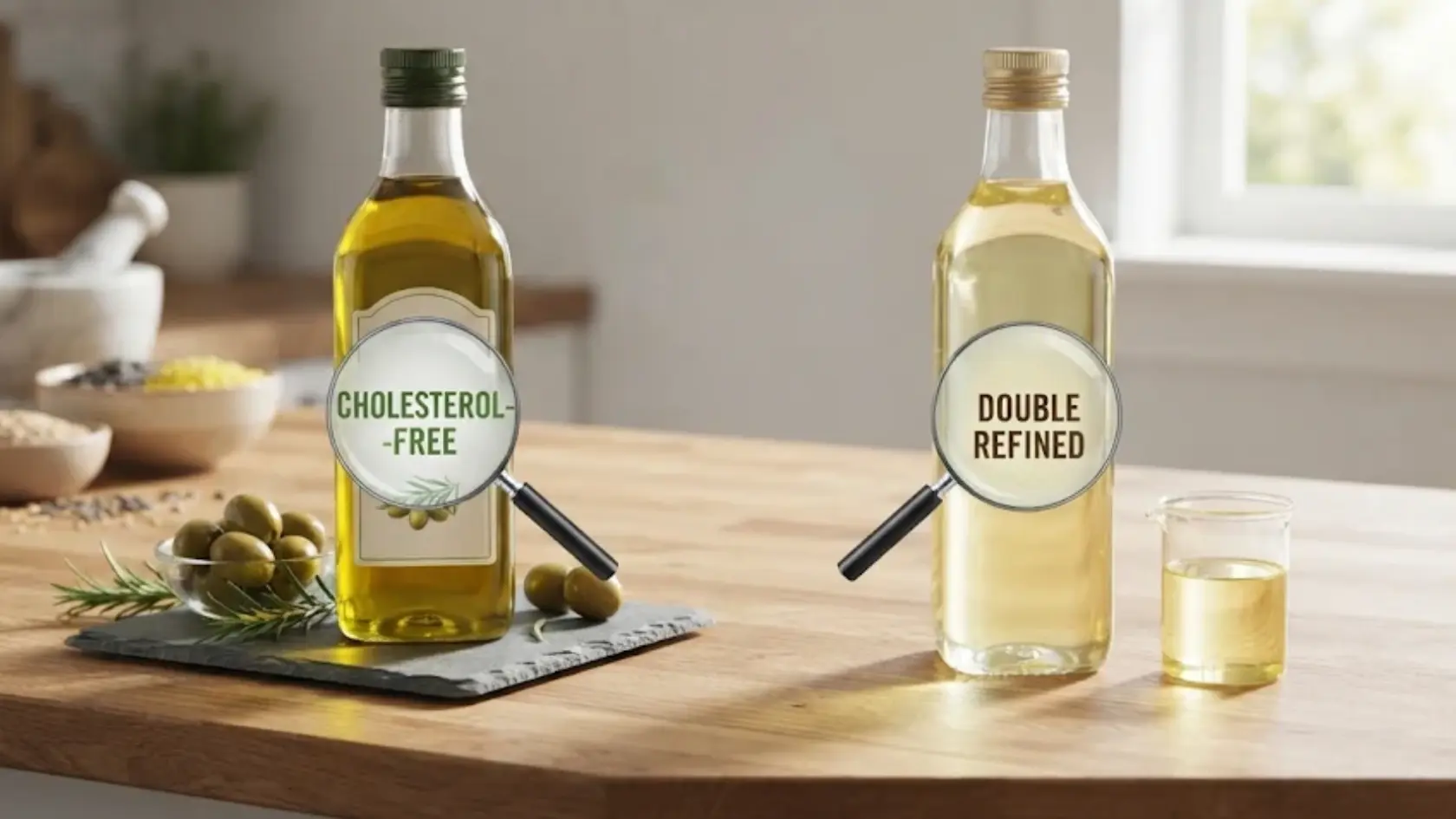
“Cholesterol-free” on a cooking oil means the oil contains no dietary cholesterol, which is true of every plant oil because cholesterol is only made by animals. “Double refined” means the oil went through an extra purification pass to remove impurities, odour and free fatty acids. Neither term tells you if an oil is heart-healthy. For that, check saturated fat, trans fat, and the type of unsaturated fats on the label.
Walk down any supermarket oil aisle and the packs shout at you: cholesterol-free, double refined, zero trans fat, rich in vitamin E, heart-friendly. Some of these claims are meaningful. Others are true of every bottle on the shelf.
This guide explains each common claim in plain words, shows you how to read the nutrition panel in 30 seconds, and helps you match the right oil to how your family actually cooks. We use the Eva range (canola, cooking oil blend, sunflower and VTF banaspati) as worked examples throughout.
What Does “Cholesterol-Free” Mean on Cooking Oil?
A cholesterol-free cooking oil contains 0 mg of dietary cholesterol per serving. All vegetable oils, including canola, sunflower, soybean, corn, olive and palm, are naturally cholesterol-free. Cholesterol is a sterol made in animal livers, so it only appears in foods like desi ghee, butter, cream, eggs and meat.
Under US FDA rules, a “cholesterol-free” claim requires less than 2 mg cholesterol and 2 g or less saturated fat per serving. Many regulators follow similar logic. The claim is accurate, but it is not a point of difference between plant oils.
Dietary Cholesterol vs. Blood Cholesterol
The cholesterol in food and the cholesterol in your blood test are linked, but not one-to-one. Research summarised by the American Heart Association and WHO shows that saturated fat and trans fat raise LDL (“bad”) cholesterol far more than dietary cholesterol does.
So a cholesterol-free oil can still push up LDL if it is high in saturated or trans fat. Palm oil, for example, is cholesterol-free but roughly 50% saturated fat.
What to Look for Instead
- Saturated fat: lower is better for most daily cooking. Eva Canola Oil contains only about 7% saturated fat, among the lowest of common oils.
- Trans fat: aim for 0 g, or 2% or less of total fat.
- Unsaturated fats: monounsaturated (MUFA) and polyunsaturated (PUFA) fats can help lower LDL when they replace saturated fat.
Bottom line: “cholesterol-free” is a true but universal claim for plant oils. Treat it as a baseline, not a buying reason.
What Does “Double Refined” Mean on Cooking Oil?
“Double refined” means the crude oil was purified in two stages, or passed through a key refining step twice, to remove more impurities, colour, odour and free fatty acids. It is a manufacturer’s descriptor, not a legally defined grade in most countries, so the exact process varies by brand.
How Cooking Oil Is Refined
Crude oil pressed or extracted from seeds contains gums, waxes, pigments, moisture and free fatty acids. Standard refining removes them in four steps:
- Degumming: water or acid removes phospholipids (gums) that cause cloudiness and foaming.
- Neutralisation: removes free fatty acids, which cause rancid taste and lower the smoke point.
- Bleaching: filtering through activated clay absorbs pigments and trace metals.
- Deodorisation: steam at high temperature and vacuum strips off odour and flavour compounds.
Winterisation, used for sunflower oil, also chills the oil to remove waxes so it stays clear in cold weather. A “double refined” oil typically repeats filtration, neutralisation or deodorisation for extra purity.
Benefits of Double-Refined Oil
- Neutral taste and smell, so it does not overpower desi or continental dishes.
- Higher smoke point (about 220-240 °C for refined canola, sunflower and soybean), which suits deep frying and tarka.
- Longer shelf life, because fewer free fatty acids and trace metals mean slower rancidity.
- Consistent clarity and less foaming in the kadhai.
Trade-Offs to Know
- Refining removes part of the natural vitamin E and polyphenols. Good brands keep or restore key nutrients; for example, Eva Sunflower Oil is positioned as rich in vitamin E (alpha-tocopherol).
- High-heat deodorisation can form trace process contaminants (3-MCPD and glycidyl esters). Modern plants control temperature and time to keep these within safety limits.
Is Double-Refined Oil Healthy?
Yes, a double refined oil can be a healthy everyday choice if its fat profile is good. Refining changes purity, taste and heat tolerance. It does not change whether the oil is mostly saturated or unsaturated. A double refined canola oil is still low in saturated fat; a double refined palm oil is still high in it.
Other Cooking Oil Label Terms, Decoded
| Label claim | What it actually means | Why it matters |
| Cholesterol-free | 0 mg dietary cholesterol; true of all plant oils | Baseline only, not a differentiator |
| Double refined | Extra purification pass for clarity, neutral taste, higher smoke point | Better for frying and shelf life; says nothing about fat type |
| 0 g trans fat | Less than 0.5 g trans fat per serving under many labelling rules | Industrial trans fat is the most harmful dietary fat for the heart |
| VTF (Virtually Trans Fat Free) | 2% or less trans fat of total fat; matches the WHO recommended limit | Key claim to look for on banaspati and vanaspati ghee |
| Low in saturated fat | Lower share of fats that raise LDL cholesterol | Canola (~7%) and sunflower (~10%) are low; palm and ghee are high |
| Rich in MUFA / PUFA | High share of monounsaturated or polyunsaturated fats | Replacing saturated fat with these may lower LDL |
| Omega-3 (ALA) | Plant omega-3; canola provides about 9% of its fat as ALA | Supports heart health as part of a balanced diet |
| Rich in vitamin E | Contains alpha-tocopherol, an antioxidant | Sunflower oil is one of the richest sources among cooking oils |
| Fortified with vitamins A & D | Vitamins added during processing | Pakistan requires fortification of edible oil and ghee to address deficiency |
| Blended oil | A mix of two or more oils, e.g. canola + soybean/sunflower | Balances fatty-acid profile, taste and cost |
| Cold-pressed / virgin | Pressed without high heat or chemicals; usually unrefined | More flavour and nutrients, lower smoke point; not ideal for deep frying |
What Is VTF Banaspati?
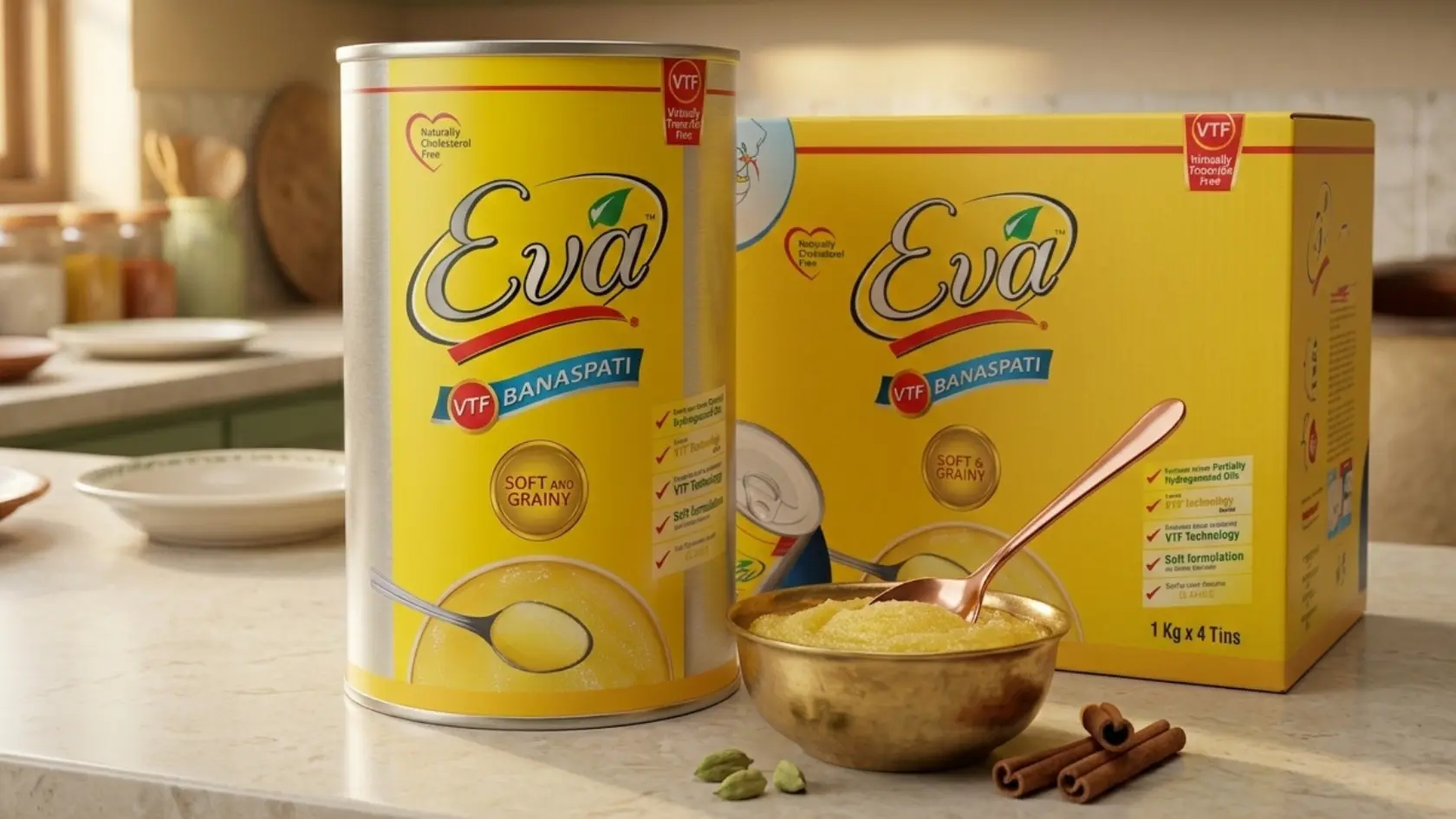
VTF banaspati is vegetable ghee formulated to be “Virtually Trans Fat Free”, meaning it contains 2% or less trans fat. Traditional banaspati was made by partial hydrogenation, which creates industrial trans fats. VTF products use modern methods such as interesterification, fractionation and full hydrogenation blending to get the same solid, grainy texture with far less trans fat. Eva VTF Banaspati follows this standard.
The WHO’s REPLACE initiative calls on countries to limit industrial trans fat to 2 g per 100 g of total fat, and Pakistan has moved to adopt this limit for oils and fats.
Smoke Point and Why “Refined” Helps Improve It
The smoke point is the temperature at which oil starts to smoke and break down. Cooking past it produces acrid flavour and oxidation compounds. Typical values:
| Oil | Approximate smoke point |
| Refined soybean oil | ~230 °C |
| Refined sunflower oil | ~225-230 °C |
| Refined canola oil | ~205-230 °C |
| Desi ghee | ~250 °C |
| Extra virgin olive oil | ~160-190 °C |
| Unrefined (cold-pressed) sunflower | ~105 °C |
Most pakora, samosa and paratha cooking happens at 160-190 °C, which refined canola, sunflower and blended oils handle comfortably.
How to Read a Cooking Oil Label in 5 Steps
To read a cooking oil label, check the oil type, saturated fat, trans fat, unsaturated fats and added nutrients, then match the oil to your cooking method. Front-of-pack claims are marketing; the nutrition panel on the back is the evidence.
- Identify the oil source. Is it single-origin (canola, sunflower, soybean) or a blend? For blends, the ingredient list shows the oils in order of quantity.
- Check saturated fat per 100 g. Under 12 g is low for an oil. Canola sits near 7 g, sunflower near 10 g, soybean near 15 g, palm near 50 g.
- Check trans fat. Look for 0 g, or “VTF” / 2% or less on banaspati. Avoid “partially hydrogenated” in the ingredients.
- Look at MUFA, PUFA and omega-3. Higher unsaturated fat is generally better for the heart. Canola is high in MUFA and has plant omega-3; sunflower is high in PUFA and vitamin E.
- Read the fine print. Check fortification (vitamins A and D), the manufacturing and expiry dates, the batch number and the food authority registration or certification marks.
Common Oils Compared (Per 100 g of Fat, Approximate)
| Oil | Saturated fat | MUFA | PUFA | Standout nutrient | Best for |
| Canola | ~7% | ~63% | ~28% | Omega-3 (ALA ~9%) | Everyday cooking, sautéing, baking |
| Sunflower (regular) | ~10% | ~20% | ~66% | Vitamin E | Frying, stir-frying, light dishes |
| Soybean | ~15% | ~23% | ~58% | Omega-3 (ALA ~7%) | Frying, general cooking |
| Olive (extra virgin) | ~14% | ~73% | ~11% | Polyphenols | Dressings, low-heat cooking |
| Palm | ~50% | ~37% | ~10% | Vitamin E (tocotrienols) | Industrial frying |
| Desi ghee | ~62% | ~29% | ~4% | Flavour, butyric acid | Occasional use, flavour finish |
Values are typical averages from USDA FoodData Central; your pack’s panel is the final word.
Which Eva Oil Should You Choose?
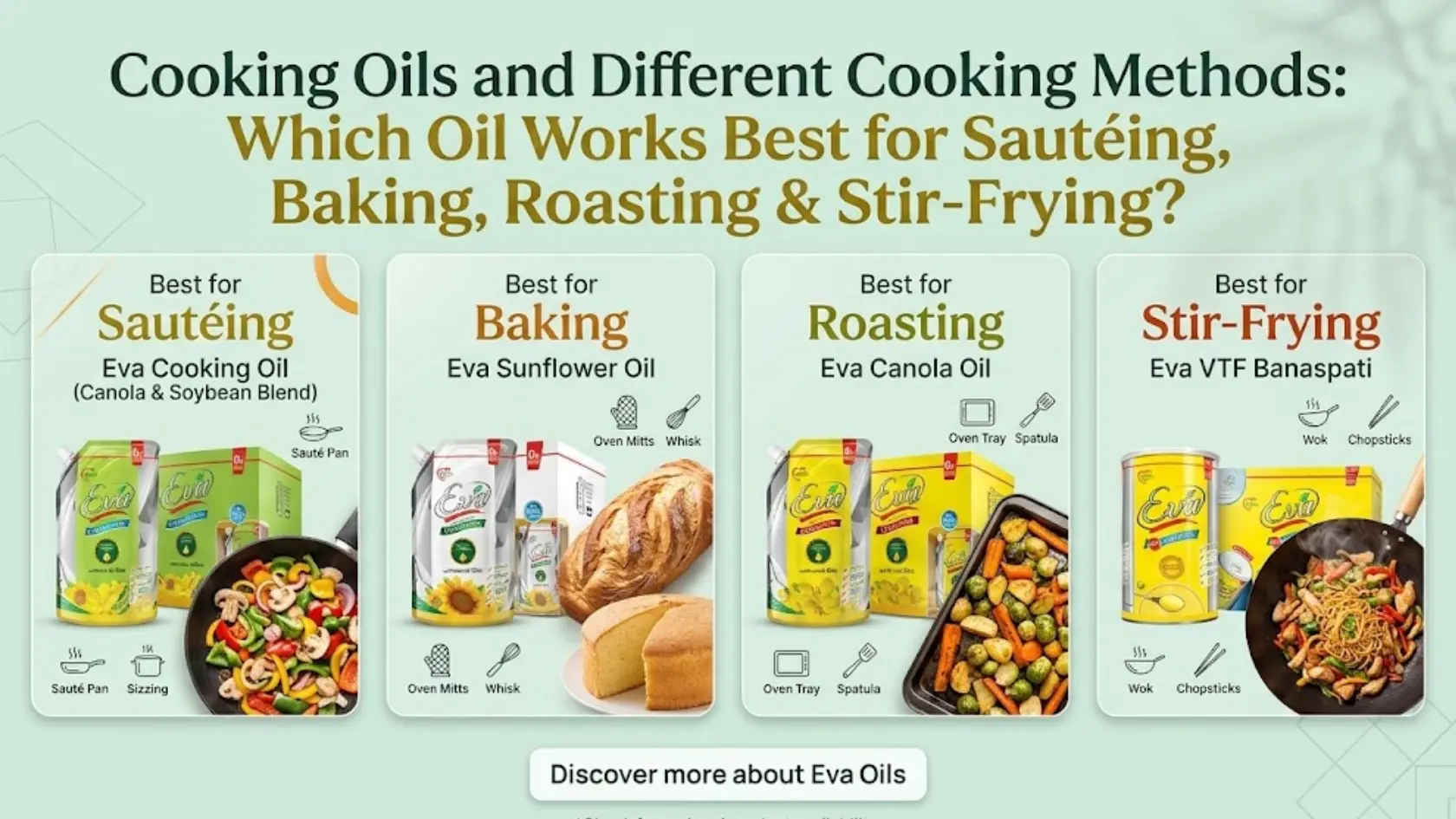
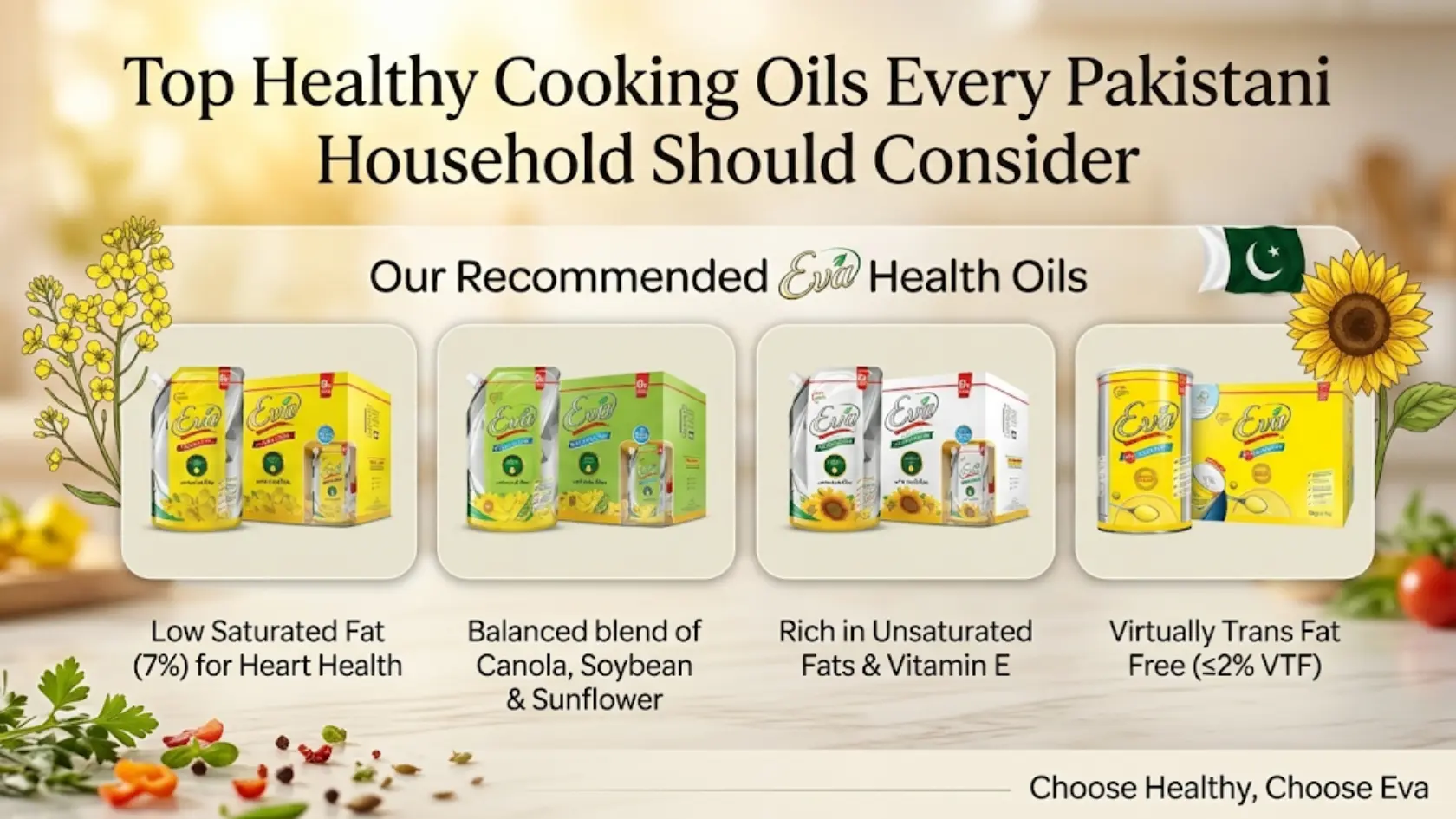
Choose Eva Canola Oil for the lowest saturated fat, Eva Sunflower Oil for vitamin E, Eva Cooking Oil for a balanced everyday blend, and Eva VTF Banaspati when a recipe needs ghee texture with minimal trans fat. All four are plant-based and naturally cholesterol-free.
| Eva product | What’s in it | Label highlight | Best for |
| Eva Canola Oil | 100% canola oil | Only ~7% saturated fat; rich in healthy fats that may help support heart health | Daily curries, sabzi, sautéing, baking |
| Eva Cooking Oil | Blend of canola and soybean/sunflower oils | Balanced nutritional profile | All-purpose family cooking and frying |
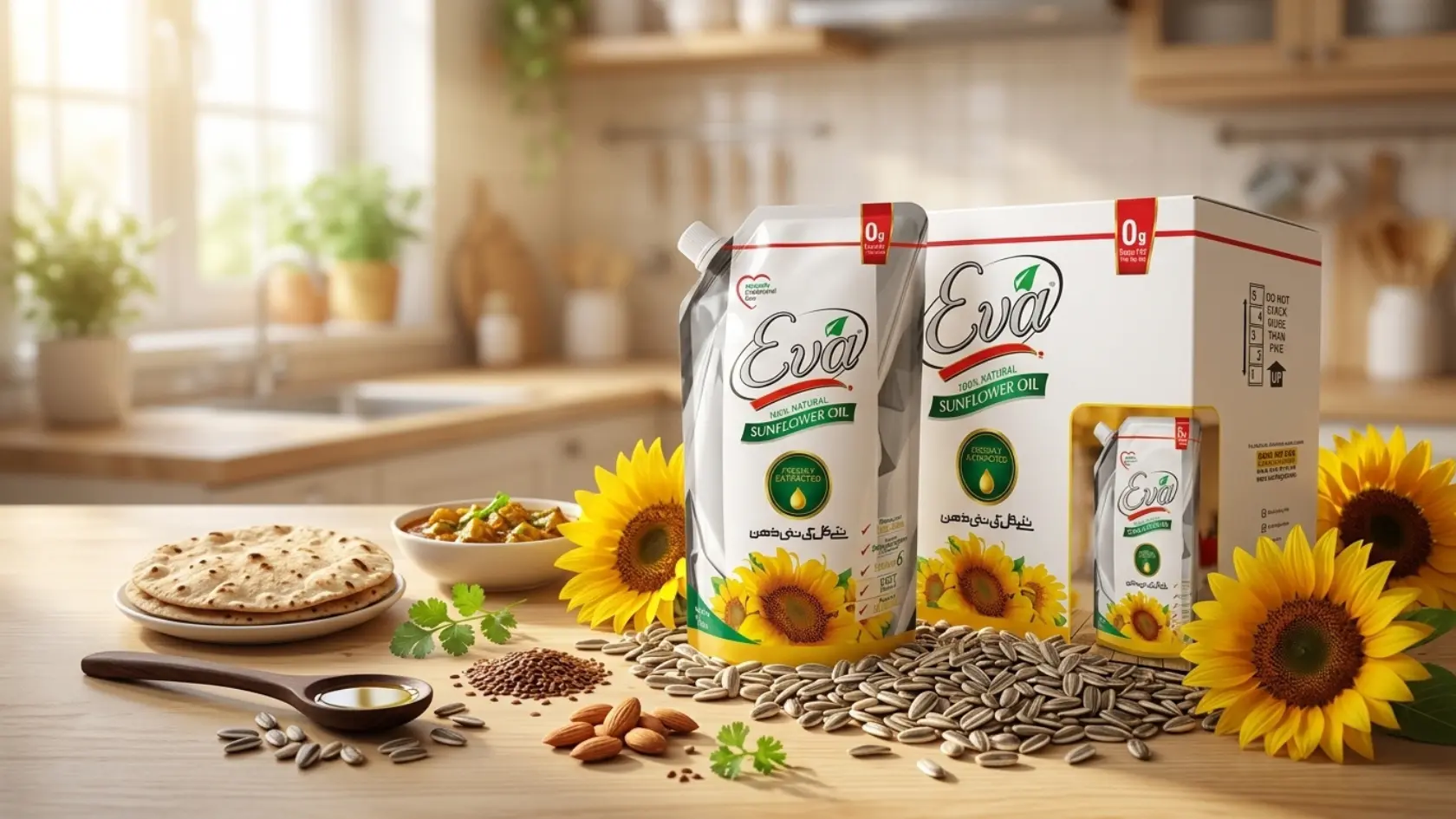
| Eva Sunflower Oil | 100% sunflower oil | Rich in unsaturated fats and vitamin E (alpha-tocopherol), a powerful antioxidant | Frying, stir-fries, light and continental dishes |
| Eva VTF Banaspati | Vegetable ghee | Virtually Trans Fat Free: 2% or less trans fat | Parathas, halwa, biryani, mithai, traditional recipes |
Matching Oil to Your Cooking
- Heart-conscious household: make Eva Canola Oil your default, and keep banaspati for occasional traditional dishes.
- Frequent frying: Eva Sunflower Oil or Eva Cooking Oil handle high heat well. Do not reuse frying oil more than once or twice, and discard it once it darkens or smells.
- Festive and traditional cooking: Eva VTF Banaspati gives the grainy, rich texture of ghee with far less trans fat than conventional vanaspati.
- One oil for everything: Eva Cooking Oil blends canola with soybean/sunflower for a practical balance of taste, heat tolerance and fatty acids.
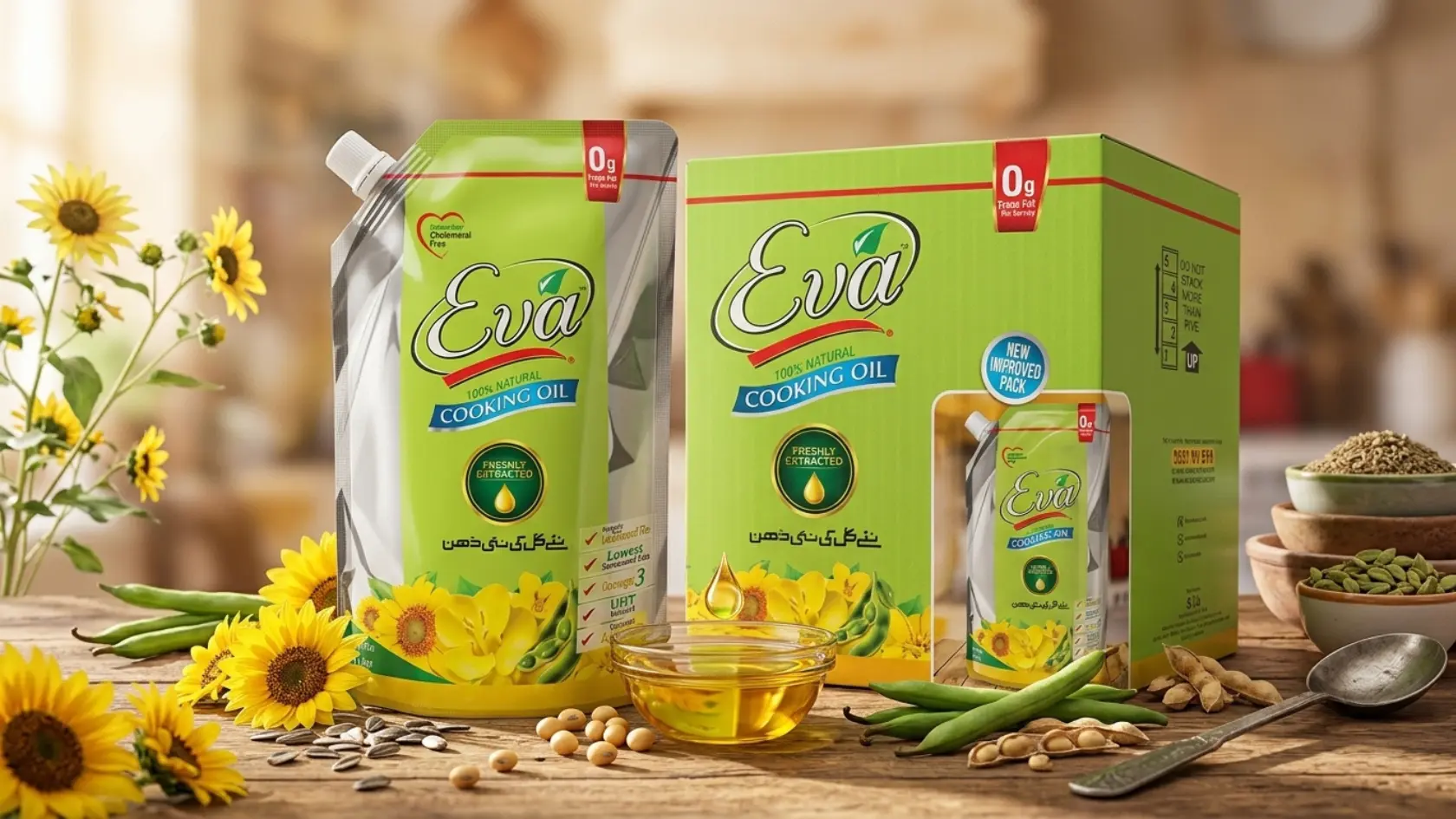
Eva oils come in convenient spouted pouches and multi-pack cartons, and Eva VTF Banaspati in tins, so you can buy the size that suits your kitchen.
Tip: rotating between canola and sunflower oil through the week gives your family a wider mix of omega-3, MUFA and vitamin E.
Cooking Oil Label Myths vs. Facts
| Myth | Fact |
| “Cholesterol-free oil won’t raise my cholesterol.” | Saturated and trans fats raise LDL more than dietary cholesterol. Check those numbers. |
| “Only premium brands are cholesterol-free.” | Every plant oil is naturally cholesterol-free. |
| “Refined oil is chemically unsafe.” | Food-grade refining is regulated and removes impurities; the finished oil is safe when made to standards. |
| “More refining always means healthier.” | Refining improves purity and heat tolerance, not the fat profile. |
| “All banaspati is full of trans fat.” | VTF banaspati is formulated to 2% or less trans fat. |
| “Unrefined oil is always better for frying.” | Unrefined oils have lower smoke points and can burn during deep frying. |
| “Healthy oil means I can use more of it.” | All oils give about 9 kcal per gram. Portion still matters. |
Everything Worth Knowing
Q1. Is all cooking oil cholesterol-free?
Yes. All plant-based cooking oils, including canola, sunflower, soybean, olive and palm, are naturally cholesterol-free. Cholesterol is found only in animal fats such as desi ghee, butter and lard.
Q2. Does cholesterol-free oil lower blood cholesterol?
Not by itself. What lowers LDL cholesterol is replacing saturated and trans fats with unsaturated fats. A low-saturated-fat oil like Eva Canola Oil, used in place of ghee or butter, can support healthier cholesterol levels as part of a balanced diet.
Q3. What is the difference between refined and double refined oil?
Refined oil goes through degumming, neutralisation, bleaching and deodorisation once. Double refined oil repeats one or more of these steps for greater clarity, a more neutral taste and a longer shelf life.
Q4. Is double refined oil bad for health?
No. Double refined oil made to food-safety standards is safe for daily cooking. Its healthfulness depends on the oil’s fat profile, not on the number of refining steps.
Q5. Which cooking oil is best for heart health?
Oils low in saturated fat and high in unsaturated fat are best for heart health. Canola oil (about 7% saturated fat, with omega-3) and sunflower oil (rich in vitamin E and PUFA) are strong everyday choices.
Q6. What does VTF mean on banaspati?
VTF stands for Virtually Trans Fat Free. It means the banaspati contains 2% or less trans fat of total fat, in line with the WHO recommended limit. Eva VTF Banaspati carries this claim.
Q7. Is canola oil better than sunflower oil?
Neither is universally better. Canola has less saturated fat and more omega-3; sunflower has more vitamin E and PUFA. Many families rotate the two, or use a blend like Eva Cooking Oil.
Q8. What does “0 g trans fat” on a label really mean?
In many labelling systems, “0 g trans fat” means less than 0.5 g per serving. Check the ingredient list for “partially hydrogenated oil” to confirm.
Q9. Can I reuse refined cooking oil for frying?
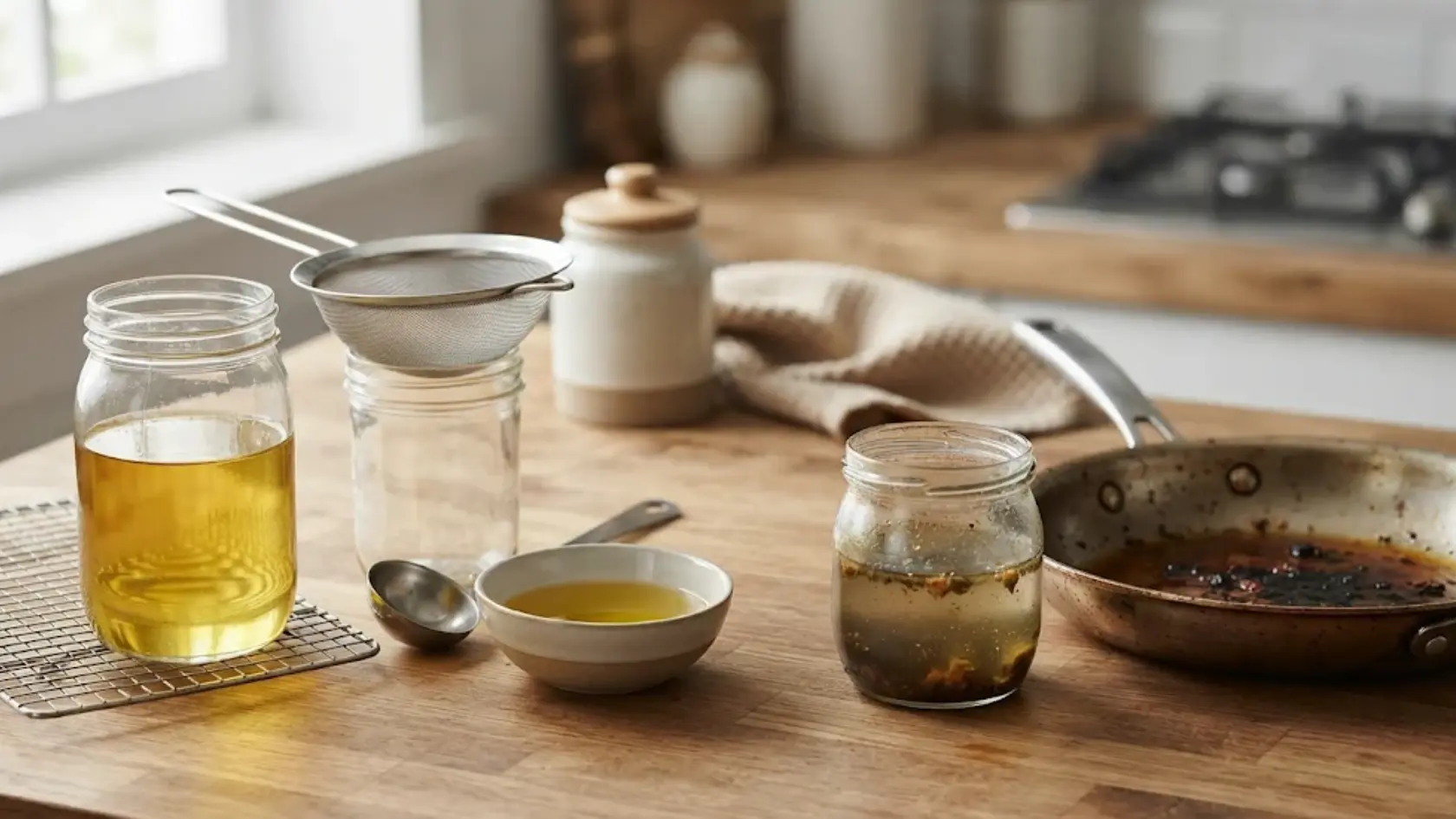
You can reuse it once or twice if you strain it and store it covered. Discard it once it darkens, foams, smells rancid or smokes at a lower temperature.
Q10. How should I store cooking oil?
Store oil in a cool, dark place, away from the stove, with the cap tightly closed. Use it before the expiry date and within a few months of opening.
The Way Forward
“Cholesterol-free” tells you an oil is plant-based, and “double refined” tells you it is pure and heat-stable. Neither tells you the whole health story. The numbers that matter are saturated fat, trans fat and the balance of unsaturated fats, plus whether the oil suits how you cook.
Once you read labels this way, choosing gets simple: a low-saturated-fat oil for daily meals, a vitamin-E-rich oil for frying, and a trans-fat-controlled ghee for tradition.
Cook smarter with Eva
From heart-friendly Eva Canola Oil and balanced Eva Cooking Oil to vitamin-E-rich Eva Sunflower Oil and Eva VTF Banaspati with 2% or less trans fat, the Eva range gives your family a clear, label-honest choice for every dish.
Explore the Eva range · Find Eva near you · Share this guide with someone who shops for the family kitchen.