What Is the Healthiest Cooking Oil for Pakistani Households?
The healthiest everyday cooking oils for Pakistani households are canola oil and sunflower oil, with a canola-soybean or canola-sunflower blend as a balanced all-rounder. Canola oil has the lowest saturated fat of common oils (about 7%) and contains plant omega-3. Sunflower oil is rich in unsaturated fats and Vitamin E. If your family prefers the taste of ghee, choose a Virtually Trans Fat Free (VTF) banaspati with 2% or less trans fat, and use it in moderation.
Pakistani food is built on oil. Tarka for daal, bhuna for karahi, deep-frying for pakoras and samosas, and slow cooking for nihari all depend on it. Because most families cook two or three oil-based meals a day, the oil in your kitchen has a bigger effect on your health than almost any other single ingredient.
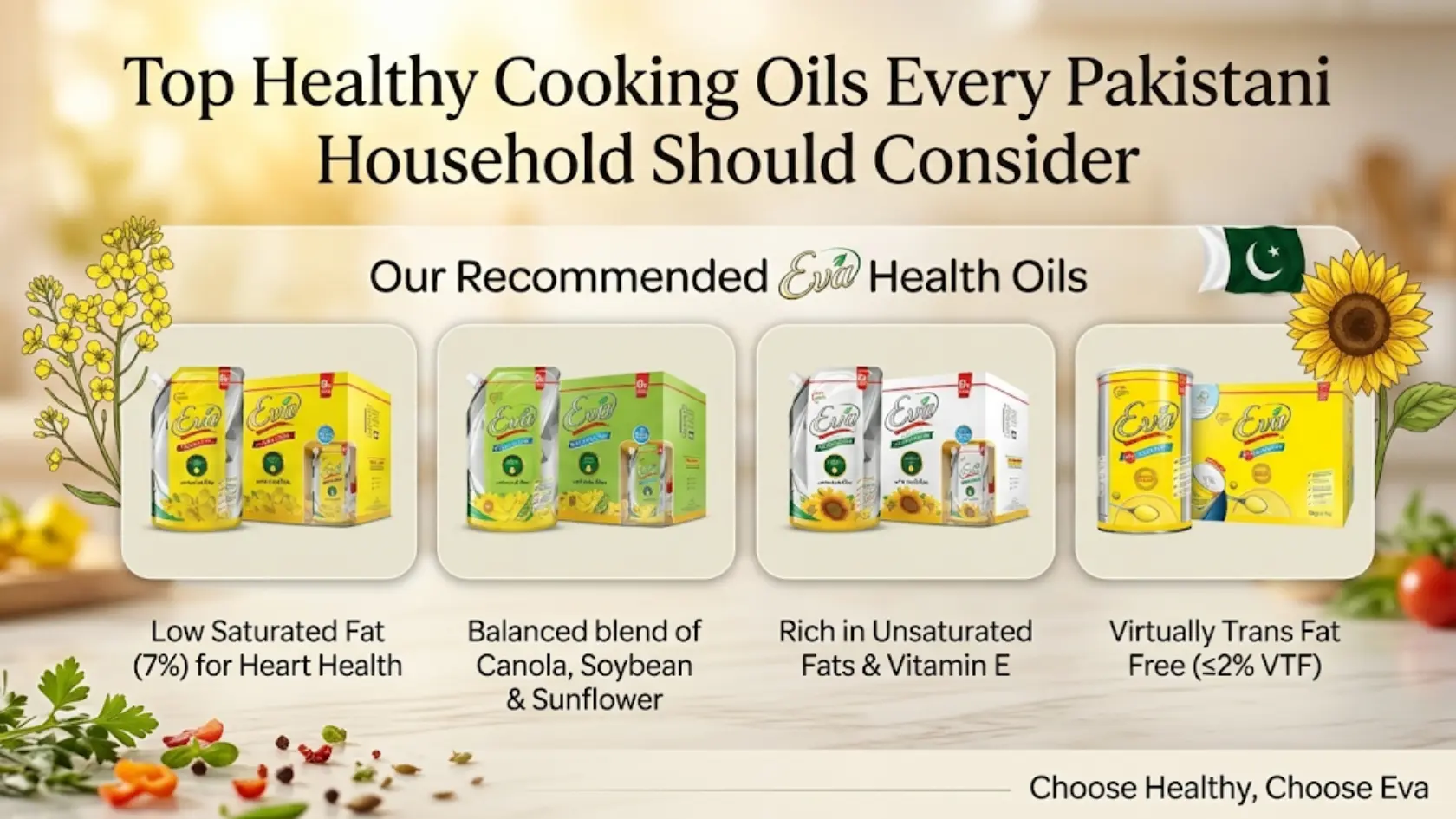
This guide explains what makes an oil healthy, compares the four oil types found in most Pakistani kitchens, and shows which one suits each desi dish. It also covers the full Eva range: Eva Canola Oil, Eva Cooking Oil, Eva Sunflower Oil and Eva VTF Banaspati.
Key facts at a glance
- Lowest saturated fat: canola oil (~7%)
- Highest Vitamin E: sunflower oil
- Best all-rounder for daily desi cooking: a canola-soybean/sunflower blend
- Healthier ghee choice: VTF banaspati (≤2% trans fat)
- Fat to avoid most: industrial trans fat from partially hydrogenated oils
Why Your Choice of Cooking Oil Matters in Pakistan
Cooking oil matters in Pakistan because heart disease is a leading cause of death and desi diets are high in fat. The type of fat you eat every day affects cholesterol, weight and long-term heart health.
- High consumption: Pakistani households use oil and ghee in nearly every meal, often in large amounts for frying and bhuna.
- Traditional banaspati habits: Older, partially hydrogenated vegetable ghee could contain high levels of trans fat, which the World Health Organization (WHO) links to heart disease.
- High-heat cooking: Tarka, karahi and deep-frying need oils that stay stable at high temperatures.
- Rising lifestyle diseases: Diabetes, high cholesterol and obesity are growing concerns, so small daily swaps add up.
Switching to an oil lower in saturated and trans fat is one of the simplest changes a family can make without changing the recipes they love.
How to Choose a Healthy Cooking Oil: 5 Factors That Matter
A healthy cooking oil is low in saturated fat, free of industrial trans fat, rich in unsaturated fats, and stable at the heat you cook with. Check these five factors on every label.
- Saturated fat (lower is better). High intake can raise LDL (“bad”) cholesterol. Canola has one of the lowest levels of any cooking oil.
- Trans fat (as close to zero as possible). Industrial trans fat raises LDL and lowers HDL (“good”) cholesterol. WHO recommends limiting it to 2 g per 100 g of total fat in foods. Look for “0 g trans fat” or “Virtually Trans Fat Free”.
- Unsaturated fats (higher is better). Monounsaturated fats (MUFA) and polyunsaturated fats (PUFA), including omega-3 and omega-6, support healthy cholesterol levels when they replace saturated fat.
- Smoke point (match it to your cooking). The smoke point is the temperature at which oil starts to break down and smoke. Refined canola, sunflower and soybean oils have high smoke points (roughly 200-230°C), suitable for tarka and deep-frying.
- Vitamins and antioxidants. Vitamin E (alpha-tocopherol) is an antioxidant that helps protect cells and the oil itself from oxidation. Sunflower oil is one of the richest sources.
Label checklist: saturated fat per 100 g, trans fat per 100 g, fortification (Vitamin A and D), manufacturing and expiry dates, and a PSQCA or food authority registration.
Top 4 Healthy Cooking Oils for Pakistani Households
These four oils cover every cooking need in a Pakistani kitchen, from light sabzi to festive biryani. Each is available in the Eva range.
1. Canola Oil: Best for Heart Health
Canola oil is the best everyday choice for heart-conscious families. It contains only about 7% saturated fat, the lowest among common cooking oils. It is high in monounsaturated fat and provides plant-based omega-3 (alpha-linolenic acid, ALA).
- Best for: daily sabzi, daal tarka, stir-fries, baking, salad dressings
- Taste: light and neutral, so spices stay in front
- Who should use it: families with a history of high cholesterol or heart disease, and anyone trying to cut saturated fat
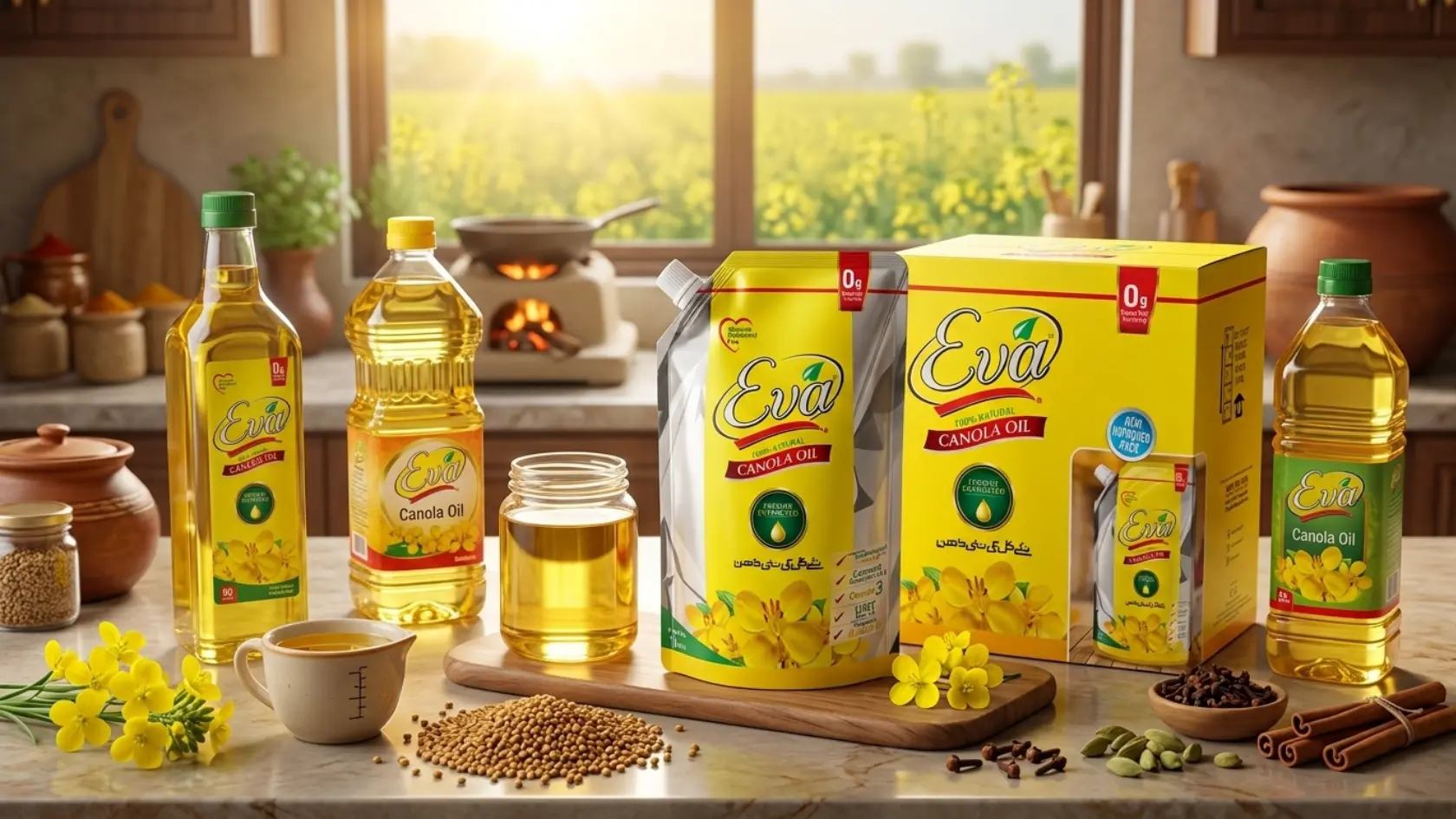
Eva Canola Oil contains only 7% saturated fat and is rich in healthy fats that may help support heart health. It comes in a spout pouch and a multi-pack carton for monthly buying.
2. Blended Cooking Oil: Best All-Rounder
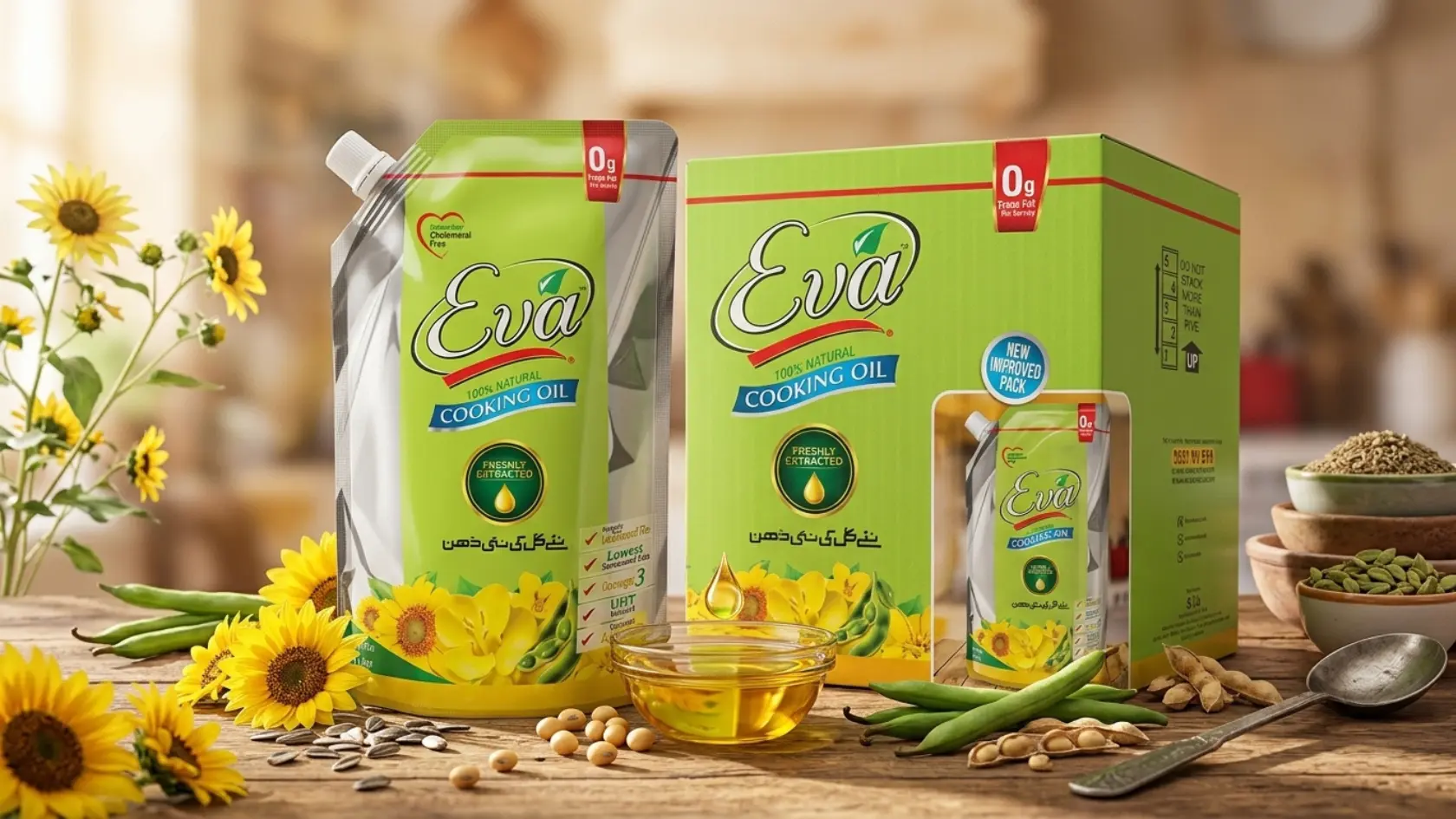
A blend of canola, soybean, or sunflower cooking oil provides balanced nutrition at an everyday price. Blending combines canola oil’s low saturated fat content and omega-3 fatty acids with the omega-6 fatty acids and vitamin E found in soybean or sunflower oil.
- Best for: all-purpose cooking, karahi, qorma, pulao, shallow frying
- Taste: neutral, works in any recipe
- Who should use it: large families who want one reliable oil for every meal
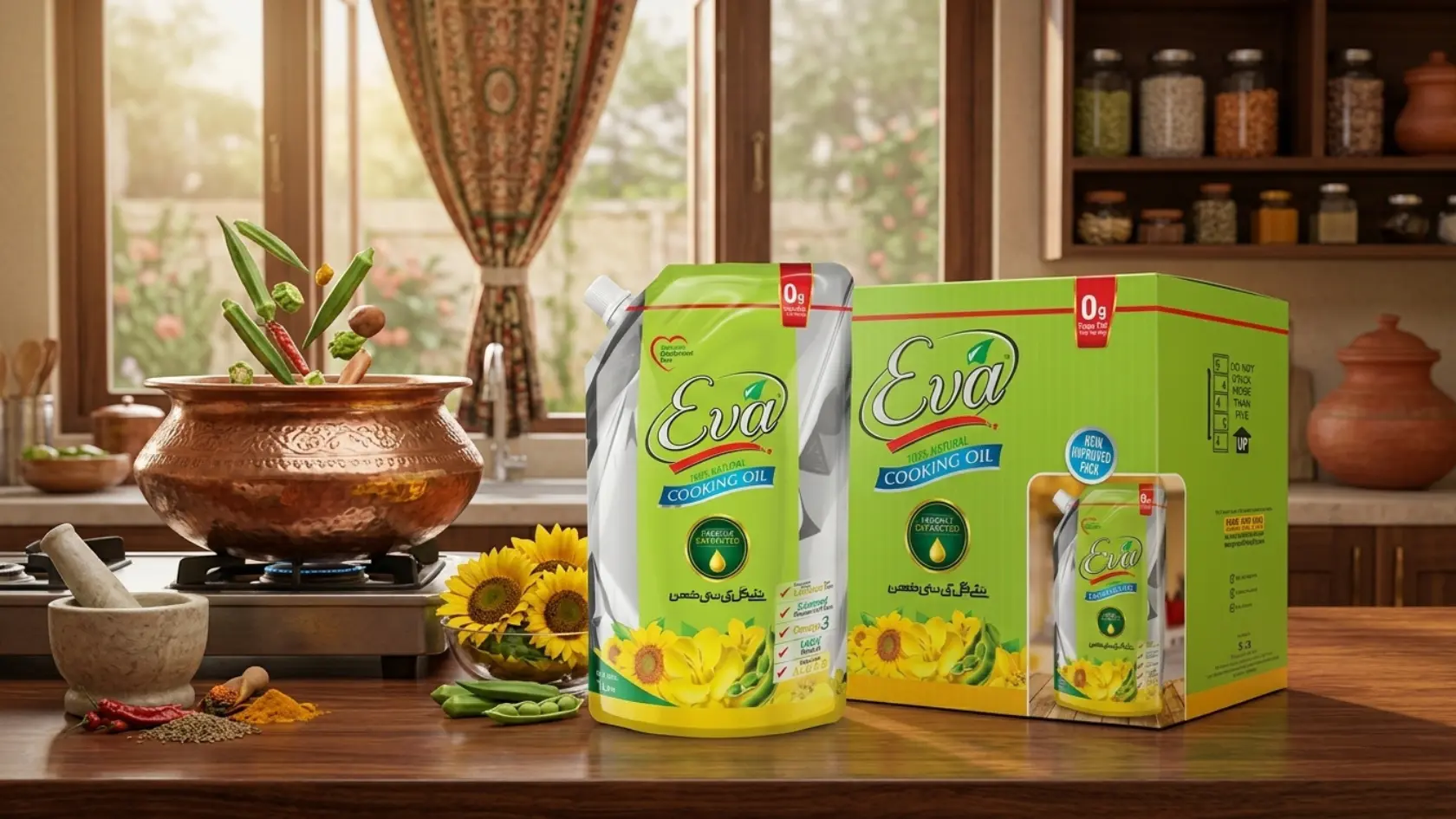
Eva Cooking Oil is a healthy blend of canola and soybean/sunflower oils, offering a balanced nutritional profile.
3. Sunflower Oil: Best for Vitamin E and Frying
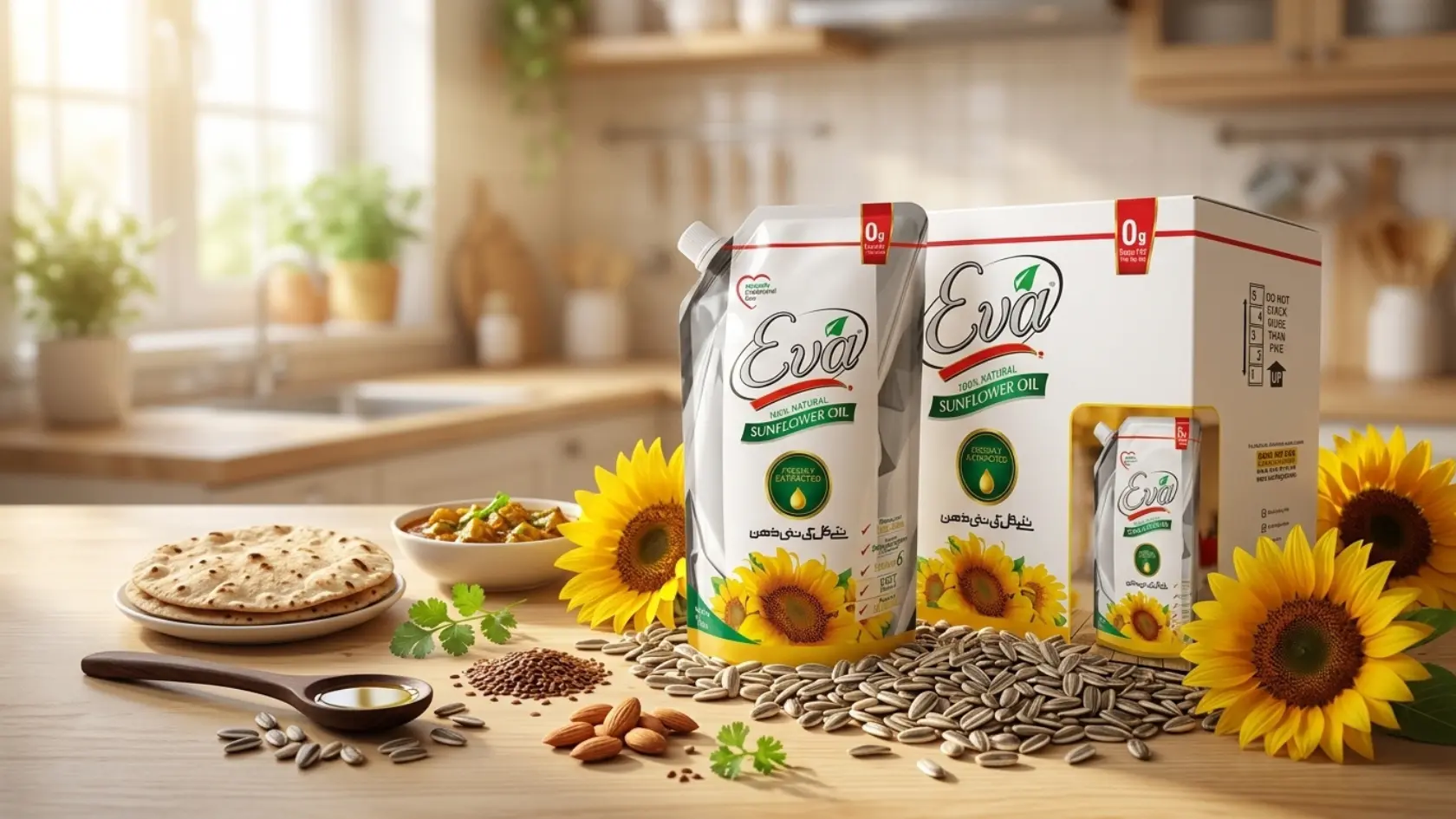
Sunflower oil is rich in unsaturated fats and one of the best natural sources of Vitamin E. Its light colour and clean taste make it popular for frying and for dishes where you want the food, not the oil, to shine.
- Best for: pakoras, samosas, fries, parathas, egg dishes, light curries
- Taste: mild and light
- Who should use it: families who fry often and want an antioxidant boost
Eva Sunflower Oil is rich in unsaturated fats and Vitamin E (alpha-tocopherol), a powerful antioxidant.
4. VTF Banaspati: Best for Traditional Ghee Taste
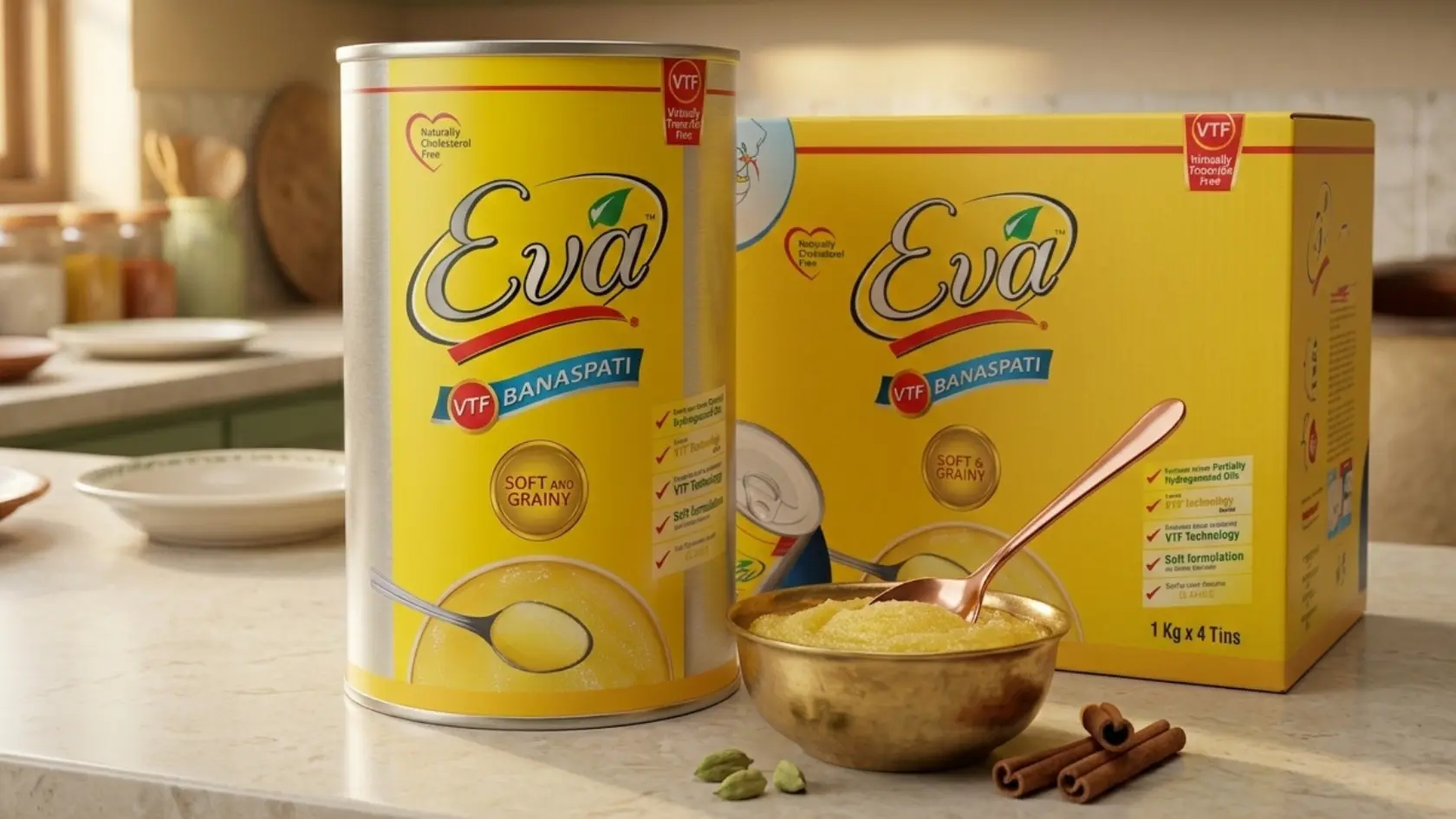
VTF banaspati is the healthier way to keep the taste of desi ghee. “Virtually Trans Fat Free” means it contains 2% or less trans fat, far lower than old-style hydrogenated ghee. It is still a solid fat, so use it in moderation.
- Best for: halwa, parathas, biryani, mithai, nihari and special-occasion cooking
- Taste: rich, traditional ghee flavour and aroma
- Who should use it: families who love ghee flavour but want to cut trans fat
Eva VTF Banaspati is a Virtually Trans Fat Free product containing 2% or less trans fat, available in tins and cartons.
Tip: Many nutritionists suggest keeping two fats at home: a liquid oil (canola, sunflower or blend) for daily cooking and a small amount of VTF banaspati for occasional dishes.
Canola vs Sunflower vs Blended Oil vs VTF Banaspati: Comparison
Canola is lowest in saturated fat, sunflower is highest in Vitamin E, blended oil is the most versatile, and VTF banaspati gives ghee flavour with minimal trans fat.
| Oil type | Saturated fat (approx.) | Standout nutrient | Smoke point (refined, approx.) | Best for | Eva product |
| Canola oil | ~7% | Omega-3 (ALA), high MUFA | ~205-230°C | Daily cooking, heart health | Eva Canola Oil |
| Blended oil (canola + soybean/sunflower) | ~8-13% | Balanced omega-3/omega-6 | ~210-230°C | All-purpose family cooking | Eva Cooking Oil |
| Sunflower oil | ~10-11% | Vitamin E (alpha-tocopherol) | ~225-230°C | Frying, light dishes | Eva Sunflower Oil |
| VTF banaspati | Higher (solid fat) | ≤2% trans fat | ~230°C | Halwa, parathas, festive dishes | Eva VTF Banaspati |
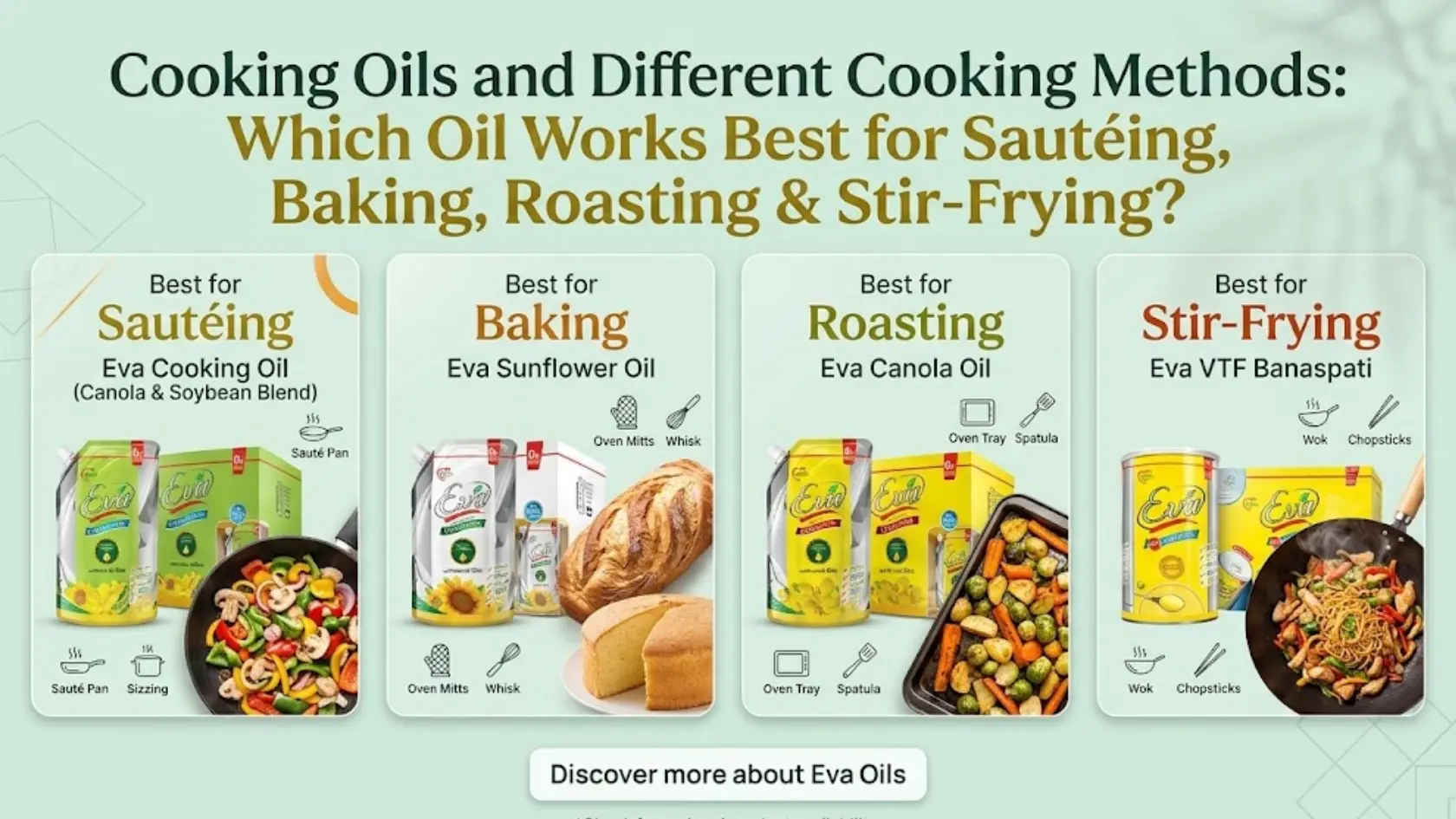
Which Oil Is Best for Which Pakistani Dish?
Use liquid oils for everyday and high-heat cooking, and save VTF banaspati for dishes where ghee flavour is the point.
| Dish | Recommended oil | Why |
| Daal tarka, sabzi, anday | Canola oil | Low saturated fat for daily meals; neutral taste lets zeera and garlic stand out |
| Chicken karahi, qorma, aloo gosht | Blended cooking oil | Stable during long bhuna; balanced nutrition |
| Pakoras, samosas, fries, fish fry | Sunflower oil | High smoke point, light and crisp results |
| Biryani, pulao | Blended oil, finished with a little VTF banaspati | Oil for cooking, ghee for aroma |
| Parathas, halwa, mithai, nihari | VTF banaspati (in moderation) | Traditional texture and flavour, low trans fat |
| Salads, raita dressings, baking | Canola oil | Mild flavour and omega-3 |
Smart Tips for Buying, Storing and Using Cooking Oil
How you store and use oil matters as much as which oil you buy.
- Measure, don’t pour. Use a tablespoon instead of pouring from the bottle; it can cut daily oil use noticeably.
- Don’t reuse frying oil repeatedly. Reheated oil breaks down and forms harmful compounds. Discard oil that turns dark, thick or smells off.
- Avoid the smoke point. If oil starts smoking, the heat is too high. Lower the flame for tarka.
- Store away from heat and light. Keep oil in a cool, dark cupboard, not next to the stove. Close the cap tightly.
- Use within the shelf life. Check the expiry date and use opened oil within a few months.
- Buy sealed, branded packs. Loose, unbranded oil may be adulterated or reused. Sealed pouches and cartons protect quality.
- Rotate your oils. Alternating canola and sunflower gives a wider range of fatty acids and nutrients.
Common Cooking Oil Myths in Pakistan
| Myth | Fact |
| All banaspati is unhealthy. | Old hydrogenated ghee was high in trans fat. VTF banaspati contains 2% or less trans fat, a much better choice when used in moderation. |
| Canola oil is not suitable for desi cooking. | Refined canola oil has a high smoke point and works well for tarka, bhuna and frying. |
| Healthy oil means you can use more. | All oils have about 9 calories per gram. Portion control still matters. |
| Sunflower oil is only for frying. | It works for curries, sabzi and baking too, and adds Vitamin E. |
| Blended oil is lower quality. | Blending is done to balance nutrition and cooking performance, not to cut quality. |
Quick Answers
Q1. Which cooking oil is best for health in Pakistan?
Canola oil is one of the best choices for daily cooking in Pakistan because it has only about 7% saturated fat and contains omega-3. Sunflower oil is a close second thanks to its Vitamin E content. Eva Canola Oil and Eva Sunflower Oil are both suited to everyday desi cooking.
Q2. Is canola oil better than sunflower oil?
Canola oil is lower in saturated fat and contains omega-3, so it is often preferred for heart health. Sunflower oil is richer in Vitamin E and very light for frying. Both are healthy; many families alternate between them.
Q3. Is banaspati ghee bad for health?
Traditional banaspati made with partially hydrogenated oil can be high in trans fat, which is linked to heart disease. VTF (Virtually Trans Fat Free) banaspati, such as Eva VTF Banaspati, contains 2% or less trans fat and is a better option when used in moderation.
Q4. What does VTF mean on banaspati?
VTF stands for Virtually Trans Fat Free. It means the product contains 2% or less trans fat, in line with the WHO-recommended limit of 2 g trans fat per 100 g of total fat.
Q5. Which oil is best for deep frying pakoras and samosas?
Refined sunflower oil is ideal for deep frying because it has a high smoke point and gives light, crisp results. Canola and blended oils also work well.
Q6. Is blended cooking oil healthy?
Yes. A blend of canola with soybean or sunflower oil combines low saturated fat, omega-3, omega-6 and Vitamin E. Eva Cooking Oil is a canola and soybean/sunflower blend designed for balanced everyday nutrition.
Q7. Can I use canola oil for desi cooking?
Yes. Refined canola oil has a smoke point of around 205-230°C, high enough for tarka, bhuna, karahi and frying. Its neutral taste keeps the flavour of spices intact.
Q8. How much cooking oil should a person use per day?
Most health guidelines advise keeping total fat to under about 30% of daily calories. For many adults that works out to roughly 3-4 tablespoons of added oil or fat a day, including cooking. Ask a nutritionist for advice on your own needs.
Q9. Is it safe to reuse cooking oil?
Reusing frying oil once, after straining, is common, but repeated reheating breaks the oil down and forms harmful compounds. Discard oil that is dark, thick, foamy or smells rancid.
Q10. Which oil is good for heart patients?
Oils low in saturated fat and free of trans fat, such as canola and sunflower oil, are generally recommended. Heart patients should follow their doctor’s or dietitian’s advice on total fat intake.
Conclusion: Choose the Right Oil for Every Meal
The healthiest kitchen is not built on one oil, but on the right oil for each job. Use canola oil for heart-friendly daily cooking, a blended oil as your all-rounder, sunflower oil for frying and Vitamin E, and VTF banaspati in moderation when only ghee flavour will do.
Above all, avoid high-trans-fat ghee, measure your portions, and don’t reuse frying oil again and again. Small, steady swaps protect your family’s heart without giving up the taste of home.
Bring Healthier Cooking Home with Eva
Whether you cook daal every day or biryani every Sunday, there is an Eva oil for your kitchen:
- Eva Canola Oil – only 7% saturated fat, for heart-conscious families
- Eva Cooking Oil – canola and soybean/sunflower blend for balanced nutrition
- Eva Sunflower Oil – rich in Vitamin E for light, crisp cooking
- Eva VTF Banaspati – traditional taste with 2% or less trans fat
Explore the Eva range and find the right oil for your family today. Look for Eva at your nearest store or order online.